For years, lead generation followed a fairly simple formula:
Run an ad → send people to a landing page → collect their details → call them → try to convert them.
That model still works.
But the way people discover businesses, research products, compare companies, and decide whom to contact is changing quickly.
AI is now appearing inside search results. Customers are using conversational tools to research businesses. Marketing teams are using AI to analyze audiences and campaigns. Messaging platforms are becoming sales channels. And businesses are collecting more data about what happens after a lead fills out a form.
These changes are creating a new lead generation environment.
By 2027, the biggest difference may not be that businesses generate more leads.
It will be that the entire process of finding, understanding, qualifying, and following up with potential customers becomes more intelligent and connected.
The traditional question was:
“How many leads did we generate?”
The more important question will increasingly become:
“How many qualified business opportunities did our marketing create?”
Current data already shows why this shift is happening.
HubSpot’s 2025 AI research found that 91% of marketing leaders said employees or teams in their organizations use AI to assist with their jobs. LinkedIn’s 2025 B2B research similarly found that 95% of B2B marketers use AI weekly and 65% use it daily or more.
At the same time, search itself is changing. A Pew Research Center analysis of 68,879 Google searches found that searches showing an AI summary produced a traditional-result click only 8% of the time, compared with 15% when no AI summary appeared.
So what does all of this mean for lead generation in 2027?
Let’s look at the changes that businesses should prepare for.
1. AI Will Move From Marketing Assistant to Lead Generation Agent
The first major change will be the role of AI.
Most businesses already use AI for tasks such as:
- Writing advertisements
- Creating social media posts
- Generating content ideas
- Summarizing reports
- Creating email drafts
- Analyzing campaign data
But these are mostly assistive tasks.
The next stage is AI taking action across the lead generation process.
For example, imagine a construction company in Gurgaon receives a new inquiry at 11:30 PM.
Instead of waiting until the next morning for a salesperson to call, an AI agent could start the conversation immediately.
It could ask:
- What type of construction project are you planning?
- Where is the property located?
- Is it residential or commercial?
- How large is the project?
- Have you already purchased the land?
- When do you want construction to begin?
The answers can then be recorded in the CRM.
If the lead meets the company’s qualification criteria, the sales team can receive an alert.
This is already moving beyond theory. Salesforce describes AI sales agents being used for outreach, follow-ups and lead qualification, with the objective of allowing human salespeople to focus on relationships and complex deals.
What changes in 2027?
The chatbot will increasingly become an active part of the sales process, rather than simply a customer-support widget.
The workflow could look like this:
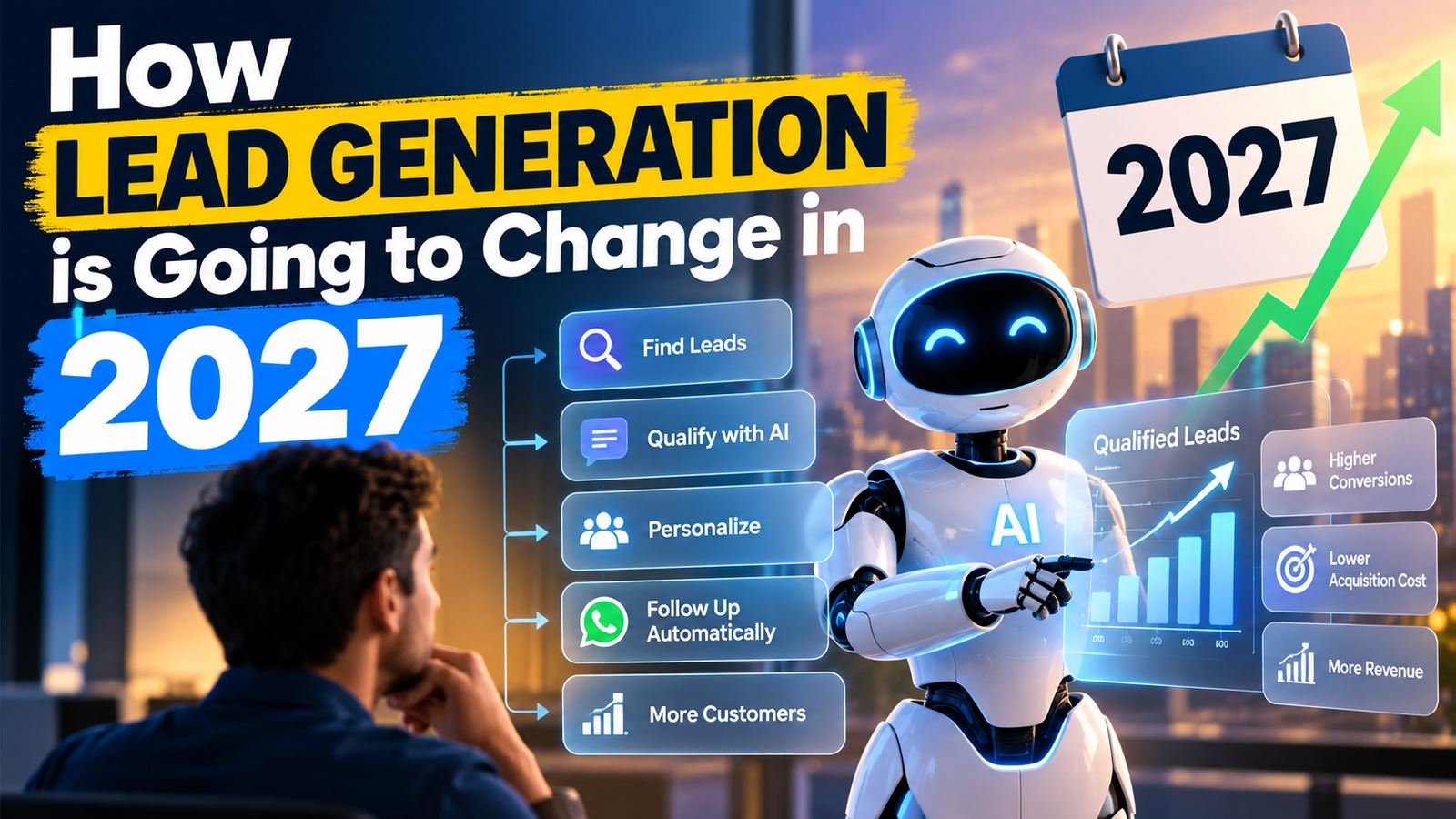
Advertisement → AI conversation → Qualification → CRM → Salesperson → Follow-up
That is very different from:
Advertisement → Form → Spreadsheet → Salesperson
2. Lead Qualification Will Happen Before the Salesperson Gets the Lead
One of the biggest problems with digital lead generation is that not every lead is equally valuable.
Suppose a company generates 100 leads.
It sounds impressive.
But imagine:
- 30 are outside the service area
- 20 have no immediate requirement
- 15 are looking for a service the company doesn’t provide
- 20 are only comparing prices
- 10 are genuine opportunities
- 5 are ready to buy
The business generated 100 leads, but its sales team really has only 15 meaningful conversations.
This is why lead qualification will become more important in 2027.
AI can use information from forms, conversations, website activity and previous interactions to help categorize leads.
For example:
| Lead Information | Possible Signal |
|---|---|
| Requested pricing | High intent |
| Requested quotation | Strong intent |
| Viewed service pages repeatedly | Interest |
| Asked implementation questions | Higher intent |
| Outside service area | Low relevance |
| No defined requirement | Early-stage |
| Requested immediate consultation | Strong buying signal |
This does not mean AI should make every sales decision.
Instead, it can help sales teams determine where human attention is most useful.
3. The Cost Per Lead Metric Will Become Less Important
For a long time, businesses have compared campaigns using Cost Per Lead (CPL).
For example:
Campaign A
100 leads × ₹500 CPL = ₹50,000
Campaign B
50 leads × ₹800 CPL = ₹40,000
At first glance, Campaign A looks better because it generated more leads at a lower cost.
But what if Campaign A generated only 5 customers while Campaign B generated 12?
The real business result is completely different.
This is why businesses will increasingly need to measure:
- Cost per qualified lead
- Cost per sales opportunity
- Lead-to-customer conversion rate
- Customer acquisition cost
- Revenue per lead
- Revenue per campaign
- Customer lifetime value
LinkedIn’s research highlights this measurement challenge. Its 2025 B2B research reported that 87% of B2B marketers struggle with measuring long-term campaign impact, while 66% face monthly scrutiny over marketing ROI.
The future dashboard will therefore look less like:
Clicks → Leads → CPL
and more like:
Spend → Leads → Qualified Leads → Opportunities → Customers → Revenue
That is a major change.
4. Search Will Become More About Being Mentioned Than Being Clicked
This may be one of the biggest changes for SEO and lead generation.
Traditional search worked roughly like this:
User searches → Google displays websites → User clicks → Website generates lead
AI-powered search can change that journey.
The user may ask a detailed question and receive an answer directly inside the search experience.
Pew Research Center’s analysis found that 58% of the U.S. adults studied had at least one Google search in March 2025 that produced an AI-generated summary. It also found that longer, question-based searches were more likely to generate AI summaries.
This creates a new challenge for businesses.
You don’t only want your website to rank.
You increasingly want your brand, expertise and content to become part of the information ecosystem that AI systems use to answer questions.
For example, instead of only targeting:
“construction company Gurgaon”
a construction company may need useful content around questions such as:
- How much does commercial construction cost in Gurgaon?
- How much does warehouse construction cost per square foot?
- What approvals are required for commercial construction?
- What should I check before hiring a construction company?
- How long does a commercial construction project take?
The goal is to become useful before the customer is ready to submit an inquiry.
5. Zero-Click Search Will Make Brand Visibility More Important
A zero-click search happens when a person gets enough information from the search results without visiting a website.
This doesn’t necessarily mean search is becoming useless for businesses.
It means the definition of search visibility is changing.
Pew’s 2025 analysis found that when an AI summary appeared, users clicked a traditional search result in 8% of visits and clicked a link within the AI summary in only 1%.
That creates an important distinction:
Traffic is not the only measure of search visibility.
A business can benefit from being:
- Mentioned
- Recommended
- Cited
- Associated with a category
- Visible for important questions
- Present in local search
- Recognized as a credible business
This is why SEO in 2027 will increasingly overlap with brand building, content marketing, digital PR and reputation management.
6. First-Party Data Will Become More Valuable
Imagine two companies running the same advertising campaign.
Company A only knows:
Name + Phone Number
Company B knows:
Name + Phone Number + Service Required + Location + Budget Range + Previous Interactions + Lead Status + Sales Outcome
Company B has much more information to improve future marketing.
This is the importance of first-party data.
Businesses will increasingly need to own and organize their customer information instead of depending entirely on advertising platforms.
Useful first-party data can include:
- Website interactions
- Form submissions
- CRM records
- WhatsApp conversations
- Previous enquiries
- Purchases
- Sales outcomes
- Customer preferences
- Email engagement
- Call outcomes
The more organized this information becomes, the more effectively businesses can segment audiences and understand which types of leads actually become customers.
7. WhatsApp Will Become a Bigger Part of the Sales Funnel
For businesses serving customers in India, this is particularly important.
A potential customer may not want to fill out a long form.
They may simply want to ask:
“How much will this cost?”
or:
“Can you handle construction in Gurgaon?”
or:
“Do you provide interior design with execution?”
Messaging can make that interaction much easier.
Meta reported in 2025 that 91% of online adults in India chat with businesses weekly, citing Kantar research. Meta also highlighted WhatsApp Business Platform capabilities for businesses expecting higher message volumes from campaigns and automation.
That suggests an important opportunity for lead generation.
Instead of:
Ad → Landing Page → Form → Email → Call
businesses can build:
Ad → WhatsApp → Conversation → Qualification → Sales
This can be particularly useful for:
- Real estate
- Construction
- Interior design
- Clinics
- Education
- Home services
- Local businesses
- Professional services
The important part is not simply having a WhatsApp number.
The business needs a process for managing those conversations.
8. Follow-Up Will Become Automated and Personalized
Generating a lead is only the first step.
The next challenge is following up.
Consider a typical salesperson handling 50–100 enquiries.
Some people respond immediately.
Some need a reminder.
Some ask for a quotation.
Some say, “I will decide next month.”
Some disappear after receiving the proposal.
Manual follow-up becomes difficult at scale.
Automation can create different journeys.
For example:
New lead
→ Immediate acknowledgement
Lead doesn’t respond
→ Follow-up after 1 day
Lead shows interest
→ Salesperson notification
Quotation sent
→ Follow-up after 2–3 days
Still undecided
→ Helpful case study or educational content
Customer converts
→ Stop sales automation and start onboarding
The future is not simply about sending more automated messages.
It is about sending the right message based on what the prospect has already done.
9. Personalization Will Move Beyond “Hi, Name”
Many businesses consider personalization to be adding someone’s first name to an email.
That is basic personalization.
The next level is personalization based on intent and context.
For example, imagine someone visits a page about commercial warehouse construction.
Instead of showing them a generic message:
“We provide construction services.”
the website could communicate:
“Planning a warehouse or industrial project? Explore construction requirements, estimated costs and project timelines.”
The same business could show different messaging to someone researching residential construction.
AI and customer data can make this type of personalization easier to implement at scale.
LinkedIn’s B2B research found that 62% of surveyed B2B marketers use AI for data analysis and audience segmentation, while 33% reported using AI for better targeting and campaign personalization.
10. Content Will Need to Become More Specific
AI has made content production dramatically easier.
That creates a problem.
If everyone can produce 50 articles using AI, producing more articles is not automatically a competitive advantage.
The advantage will come from producing useful and specific information.
Compare these two topics:
Generic
“Benefits of Digital Marketing for Businesses”
Specific
“How Much Should a Local Clinic Spend on Google Ads in 2027?”
The second topic answers a much more specific commercial question.
The same principle applies to every industry.
Real Estate
Instead of:
“Why You Should Invest in Real Estate”
create:
“What Should You Check Before Buying a Commercial Property in Gurgaon?”
Construction
Instead of:
“Benefits of Commercial Construction”
create:
“How Much Does Warehouse Construction Cost Per Square Foot in 2027?”
Interior Design
Instead of:
“Why Hire an Interior Designer?”
create:
“3BHK Interior Design Cost in Gurgaon: What Should You Budget For?”
Specific content attracts people with specific problems.
And specific problems are often closer to commercial intent.
11. Trust Will Become More Important as AI Content Increases
There is an interesting contradiction in AI-powered marketing.
AI makes it easier to create content.
But when everyone can create content, trust becomes harder to earn.
LinkedIn’s 2025 B2B research emphasizes trust as an increasingly important factor in B2B marketing, particularly as buyers become more self-directed and buying journeys become more complex.
This means businesses will need more than AI-generated articles.
They will need:
- Real case studies
- Customer reviews
- Original research
- Expert opinions
- Demonstrations
- Before-and-after examples
- Videos
- Industry experience
- Transparent pricing where appropriate
- Strong business profiles
- Real people behind the brand
AI can help produce content.
But evidence creates credibility.
12. Local SEO Will Remain a Major Lead Generation Channel
AI may change search, but local businesses will still need to be discoverable when customers search for services nearby.
Google says local search results are primarily influenced by relevance, distance and prominence. It also recommends maintaining complete and accurate Business Profile information.
For a local business, this means lead generation in 2027 will still involve fundamentals such as:
- Google Business Profile
- Accurate business information
- Reviews
- Photos and videos
- Local service pages
- Location-specific content
- Website quality
- Relevant mentions and links
- Fast response to enquiries
For example, a customer searching:
“interior designer near me”
doesn’t necessarily want to read a 2,000-word article.
They want to know:
Who is available?
Where are they located?
Do they provide the service I need?
Can I trust them?
How can I contact them?
Local lead generation will therefore increasingly combine search visibility with reputation and conversion experience.
13. Lead Generation Will Become Omnichannel
Customers don’t necessarily discover and buy from a company through the same platform.
A person might:
- See an Instagram video.
- Search the company on Google.
- Read reviews.
- Visit the website.
- Watch a YouTube video.
- Click a Meta advertisement.
- Start a WhatsApp conversation.
- Speak with a salesperson.
- Return to Google.
- Finally become a customer.
This journey is fragmented.
LinkedIn describes modern B2B buying journeys as nonlinear and cross-channel, with buyers researching across devices and platforms before talking to sales.
That means businesses should stop thinking about every platform as an isolated lead source.
Instead:
Google + Meta + Instagram + YouTube + Website + WhatsApp + CRM
should work as parts of one customer journey.
14. AI Will Help Marketing Teams Analyze Campaigns Faster
Another major change will happen after the lead has been generated.
Marketing teams will increasingly use AI to answer questions such as:
- Which campaign produces the best leads?
- Which ad generates customers rather than just enquiries?
- Which locations convert better?
- Which audience has the highest sales value?
- Which landing page generates qualified leads?
- Where are leads dropping out?
- Which salespeople are converting the most opportunities?
- What type of content influences conversion?
This matters because raw data is not the same as useful information.
A spreadsheet may contain thousands of rows.
The business needs to know:
“What should we change because of this data?”
That is where AI-powered analysis can become valuable.
15. Human Salespeople Will Still Be Important
It would be easy to assume that AI will replace salespeople.
The more realistic change is that AI will take over more repetitive tasks while humans focus on higher-value conversations.
AI can help with:
- Lead qualification
- Data entry
- Research
- Follow-up reminders
- Basic questions
- Meeting scheduling
- Personalized outreach
- Reporting
Humans remain important for:
- Negotiation
- Relationship building
- Complex requirements
- High-value decisions
- Objection handling
- Trust
- Strategic discussions
Salesforce’s description of AI sales agents reflects this direction: automate repetitive sales work while allowing human teams to focus on customer relationships and complex deals.
So the future is unlikely to be:
AI replaces salespeople.
It is more likely to be:
AI handles more of the repetitive work → salespeople spend more time on valuable opportunities.
What Will the Lead Generation Funnel Look Like in 2027?
The traditional funnel:
Advertisement
↓
Landing Page
↓
Lead Form
↓
Sales Call
↓
Customer
is becoming more sophisticated.
A future-oriented funnel could look like this:
Content / Advertisement / Search
↓
Website / AI Search / Social Media
↓
Conversation
↓
AI-Assisted Qualification
↓
CRM
↓
Lead Scoring
↓
Personalized Follow-Up
↓
Human Sales Conversation
↓
Opportunity
↓
Customer
↓
Customer Data
↓
Campaign Optimization
The final stage is important.
The system learns from what happened to previous leads.
That information can then improve future campaigns.
So the funnel becomes a continuous feedback loop, rather than a one-way process.
What Businesses Should Start Doing Before 2027
Businesses don’t need to completely rebuild their marketing systems overnight.
Instead, start with the fundamentals.
1. Stop measuring only leads
Start tracking qualified leads, opportunities and customers.
2. Connect your CRM with marketing
Your advertising platform should not be the only place where campaign performance is measured.
3. Build first-party data
Keep useful information about leads, customers and sales outcomes in a structured system.
4. Start using AI for qualification
Experiment with AI for answering questions, collecting requirements and categorizing leads.
5. Build a WhatsApp sales process
Don’t just put a WhatsApp button on your website. Create a structured process for handling conversations and follow-ups.
6. Create specific content
Answer the questions customers actually ask before buying.
7. Strengthen your local presence
For local businesses, keep Google Business Profile, reviews, website and local content updated.
8. Create proof
Publish real projects, case studies, reviews, demonstrations and original insights.
9. Automate repetitive follow-ups
Let automation handle predictable tasks so salespeople can focus on conversations that require human judgment.
10. Prepare for AI-powered search
Don’t focus only on ranking keywords.
Build a brand and content ecosystem that demonstrates expertise and provides information worth referencing.
The Biggest Change: From Lead Generation to Lead Intelligence
The biggest change in 2027 may not be a particular advertising platform or AI tool.
It will be the shift from lead generation to lead intelligence.
Generating a lead is relatively easy.
Understanding that lead is harder.
A modern system needs to understand:
Who is this person?
What are they looking for?
How serious are they?
What information have they already seen?
What should happen next?
Did the lead become a customer?
How much revenue did the customer generate?
When marketing systems can answer these questions, businesses can make better decisions about their advertising, content, sales and follow-up.
Final Thoughts
Lead generation in 2027 is likely to be more connected, conversational, personalized and data-driven.
AI will automate more repetitive work.
Search will become more answer-oriented.
Messaging will become an increasingly important part of customer acquisition.
Lead qualification will happen earlier.
First-party data will become more valuable.
Businesses will care more about qualified opportunities and revenue than raw lead volume.
But one thing is unlikely to change:
People still need a reason to trust a business before they buy from it.
Technology can help a company find the right audience, respond faster, qualify enquiries and automate follow-ups.
It cannot replace the need for a useful service, a credible brand, good customer experience and genuine proof.
The businesses preparing for 2027 should therefore not ask only:
“How can we generate more leads?”
They should ask:
“How can we build a system that attracts the right people, understands their intent, responds at the right moment, and turns qualified opportunities into customers?”
That is where the next generation of lead generation is heading.
Key Takeaways
| Change | What It Means for Businesses |
|---|---|
| AI agents | More automated qualification and follow-up |
| AI search | Visibility will increasingly include being mentioned or cited |
| First-party data | Businesses need better ownership and organization of customer data |
| WhatsApp & messaging | Conversations can become part of the acquisition funnel |
| Lead scoring | Sales teams can prioritize higher-intent opportunities |
| Better measurement | Qualified leads and revenue matter more than raw lead volume |
| Personalization | Marketing messages will increasingly depend on intent and context |
| Local SEO | Reviews, relevance, proximity and prominence remain important |
| Content | Specific, useful and evidence-backed content becomes more valuable |
| Human sales | People remain important for trust, negotiation and complex decisions |
The future of lead generation isn’t simply about generating more leads. It’s about making every stage between discovery and revenue smarter.